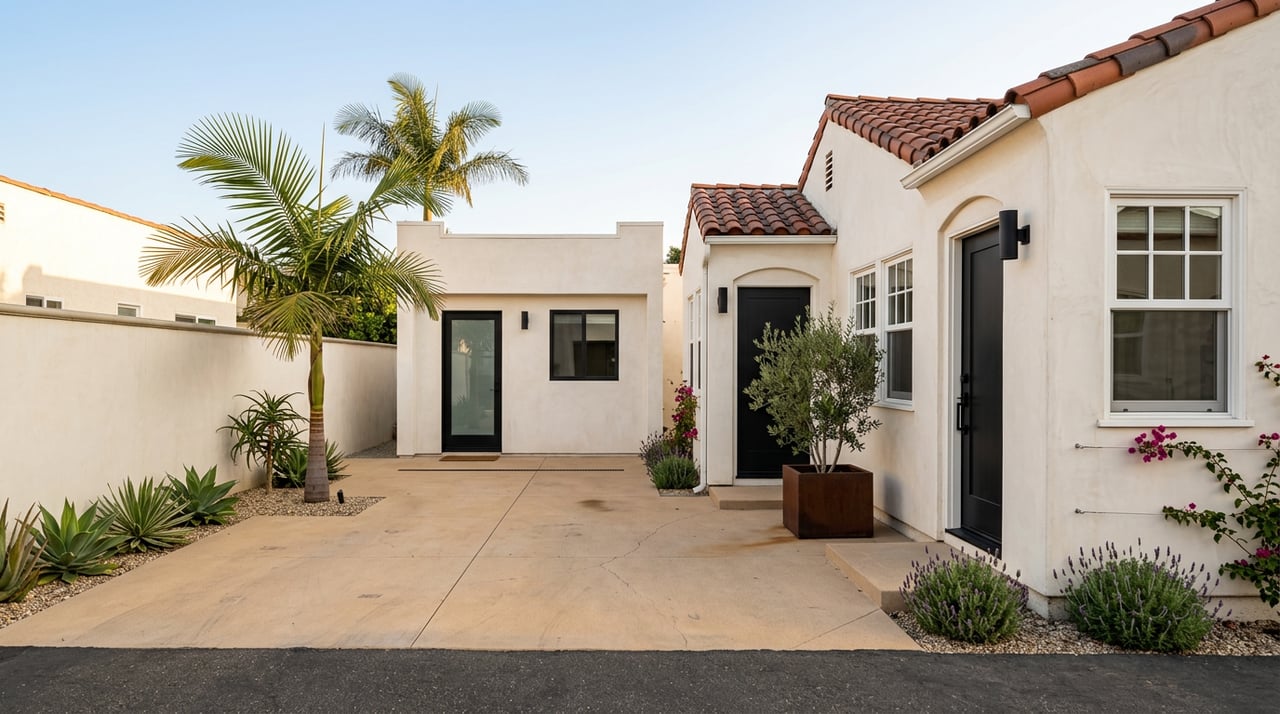
What if your first home in City Heights could help pay the mortgage? If you are weighing rising costs and want a smart way to enter the San Diego market, house hacking can turn your home into a financial tool. In this guide, you will learn the setups that work best in City Heights, the numbers to watch, permit and cost basics, and a simple underwriting checklist you can use on any property. Let’s dive in.
Why City Heights fits house hacking
City Heights blends relative affordability with flexible housing options. The neighborhood’s median sale price has hovered near roughly $645,000 in recent data, which is lower than many coastal San Diego areas. The housing stock includes many small multifamily buildings and older single‑family lots that can often fit an ADU, so you have multiple paths to create rental income.
Rents in the 92105 area commonly fall in ranges that help the math. One‑bedroom units often lease around $1,700 to $1,900 per month, and two‑bedroom units around $2,000 to $2,300 per month, depending on condition and layout. When you underwrite, use conservative assumptions and verify with recent local comps.
Three practical house‑hack setups
Buy a 2–4 unit and live in one
Small multifamily properties are common in City Heights, and living in one unit while renting the others is a classic starting point. This can offset a large share of your monthly payment and may position you for future equity growth.
Financing is often accessible for owner‑occupants. FHA guidelines allow you to buy 2–4 unit properties with low down payment options when you qualify. The FHA handbook also explains the required small income property appraisal report, how projected rents may be used in qualifying, and the self‑sufficiency test that applies to 3–4 unit properties. Duplexes are simpler because the self‑sufficiency test does not apply to 2‑unit purchases. Review details in the HUD Single‑Family Handbook 4000.1 and compare lenders with experience in 2–4 unit loans.
Single‑family plus ADU or JADU
Adding a backyard ADU or converting a garage can create a separate long‑term rental. The City of San Diego allows ADUs and JADUs on many single‑family lots, subject to objective standards. You can find current rules, including size and setback limits and JADU owner‑occupancy, in the city’s ADU portal and Information Bulletin 400.
Plan for long‑term leases. Under the city’s short‑term rental ordinance, ADUs cannot be used as short‑term rentals, so Airbnb‑style strategies are off the table for newly permitted ADUs. Review the rules on the city’s Short‑Term Residential Occupancy page.
Costs and timelines vary. Local San Diego projects often range from about $150,000 for a simple garage conversion to $300,000–$450,000 or more for a detached, turnkey ADU, depending on size, finishes, utility work, and site conditions. Review cost guides like this San Diego overview of ADU cost drivers and ranges. For simple conversions or pre‑approved plans, a 3 to 6 month permit‑to‑completion window is common in San Diego when submissions are complete and the scope is straightforward. See a local timeline explainer from ADUScale’s San Diego guide.
Rent rooms in your home
If you want the lowest up‑front cost, consider renting one or two bedrooms on a long‑term basis. This strategy avoids ADU construction and can still cover meaningful monthly costs. If you plan to offer short‑term stays, confirm license requirements and restrictions under the city’s STRO program. Long‑term room rentals are often simpler, but check any HOA or mortgage rules before you proceed.
Permits, timelines, and fees in San Diego
Building or converting an ADU or JADU in San Diego requires a formal permit and plan review. The city maintains objective standards and offers resources that can speed plan check when you submit complete documents. Start with the ADU toolkit and Development Services to understand current forms, plan sets, and inspection steps. The city has updated some ADU rules in recent code cycles, so confirm whether new standards apply to your parcel and project timeline.
You can improve feasibility by using any available fee reductions or programs. State ADU law reduces certain impact fees for smaller units, and local agencies have offered financing support windows in the past. Review state‑level guidance on ADU policy and fee relief and ask your lender and city contacts about current incentives before you finalize a budget.
Underwriting checklist you can reuse
Use this short framework on each property so you compare apples to apples.
- Feasibility and due diligence
- Confirm your lot’s ADU/JADU eligibility and objective standards using the city’s ADU portal and Information Bulletin 400.
- For 2–4 unit purchases, get copies of leases and expenses. If a unit is vacant, plan on appraiser‑derived market rents. FHA small income property rules are in the HUD Single‑Family Handbook 4000.1.
- Cost and permit estimate
- Get at least two local GC or ADU builder bids. Include permit fees, utility upgrades, potential sprinklers or accessibility items, and a 10 percent contingency. San Diego ranges are often in the low‑to‑mid six figures depending on scope. Cross‑check with a local ADU cost breakdown.
- Financing path
- For 2–4 units, evaluate FHA owner‑occupied options and confirm current county loan limits. Duplexes are usually more straightforward to qualify than 3–4 units because of the self‑sufficiency test. For ADU construction, explore construction‑to‑perm loans, a HELOC, or any local agency programs referenced by state ADU guidance.
- Basic underwriting math
- Gross annual rent = sum of monthly market rents × 12
- Vacancy and collections allowance = gross × 5–10 percent
- Operating expenses = gross × 30–45 percent, depending on age and condition
- Net operating income (NOI) = gross − vacancy − operating expenses
- Debt service = monthly mortgage principal and interest + property tax + insurance
- Cash flow = NOI − debt service
- Cash‑on‑Cash return = annual cash flow ÷ cash invested (down payment + closing + any renovation shortfall)
Example: what a City Heights duplex can look like
Here is a simple example to show the math. Numbers are illustrative and not a rate quote.
- Purchase price: $645,000
- Rents: 2‑bed unit at $2,100 and 1‑bed unit at $1,800. Gross monthly rent is $3,900, or $46,800 per year.
- Allowances: Vacancy at 8 percent and operating expenses at 35 percent combined. Estimated NOI is $46,800 × (1 − 0.43) ≈ $26,676.
- Financing: An FHA owner‑occupied loan with 3.5 percent down is a common path for eligible buyers. Lenders can use a portion of projected rents in qualifying. For triplex and fourplex purchases, the FHA self‑sufficiency test applies. See the HUD Single‑Family Handbook 4000.1 for the exact rules.
Interpretation: If annual debt service is at or below about $26,676, the rents could cover most or all of your housing cost. If debt service runs higher, improve the plan with a bigger down payment, a more modest renovation scope, or stronger rent assumptions supported by comps.
Rules and risks to confirm
- Short‑term rentals. ADUs generally cannot operate as short‑term rentals under San Diego’s rules. Verify license availability and categories on the city’s STRO page.
- ADU counts and occupancy. Confirm how many ADUs and JADUs are allowed, size limits, and any owner‑occupancy rules for JADUs in Information Bulletin 400.
- Property tax reassessment. New construction such as an ADU is typically added to the tax roll. Expect a supplemental bill for the new value and a higher ongoing base. See county guidance on new construction assessments.
- Insurance. Converting space to a rental or adding an ADU changes risk. Price landlord or dwelling coverage early and budget for higher premiums.
Getting started in City Heights
- Tour 2–4 unit properties and ADU‑friendly single‑family lots so you can compare options side by side.
- Pull fresh rent comps and run the underwriting checklist above with both conservative and optimistic rent cases.
- Speak with an experienced lender about 2–4 unit FHA options and any construction or renovation financing.
- If an ADU is part of your plan, meet with a local GC and gather two bids that include permits, utilities, and a contingency.
- Map your management plan, reserves, and a 12‑month maintenance budget before you write an offer.
If you want a local sounding board with renovation insight and investor experience, let’s talk. I work in English and Spanish and can help you pressure‑test a plan, source properties, and coordinate ADU or light‑rehab steps. Connect with Jonathan A Tapia to get started.
FAQs
Can I use FHA to buy a duplex in City Heights?
- Yes. FHA permits owner‑occupied financing on 2–4 unit properties and allows projected rents in qualifying under specific rules. Duplexes do not need to meet the 3–4 unit self‑sufficiency test. Review details in the HUD Single‑Family Handbook 4000.1.
Can I short‑term rent an ADU in San Diego?
- Generally no. San Diego’s short‑term rental ordinance prohibits ADUs from operating as short‑term rentals, so plan for leases of 30 days or longer. See the city’s STRO guidance.
How much does a simple ADU cost in City Heights?
- Local ranges often start near $150,000 for a garage conversion and run $300,000–$450,000 or more for detached ADUs, depending on size and site work. Review San Diego cost drivers in this ADU cost guide.
Will adding an ADU raise my property taxes?
- Yes, the new construction portion is typically reassessed and added to your tax base. Expect a one‑time supplemental bill and a modest permanent increase. See county details on new construction assessments.